Building a custom pool in Perth sand and limestone
Spearwood and Bassendean sands, Tamala limestone pinnacles and a high water table decide the hole before the interior sample does. Perth is a coastal sand city with rock that appears without warning.
Custom Pools editorial team · 6 January 2026 · Updated 20 January 2026 · 19 min read
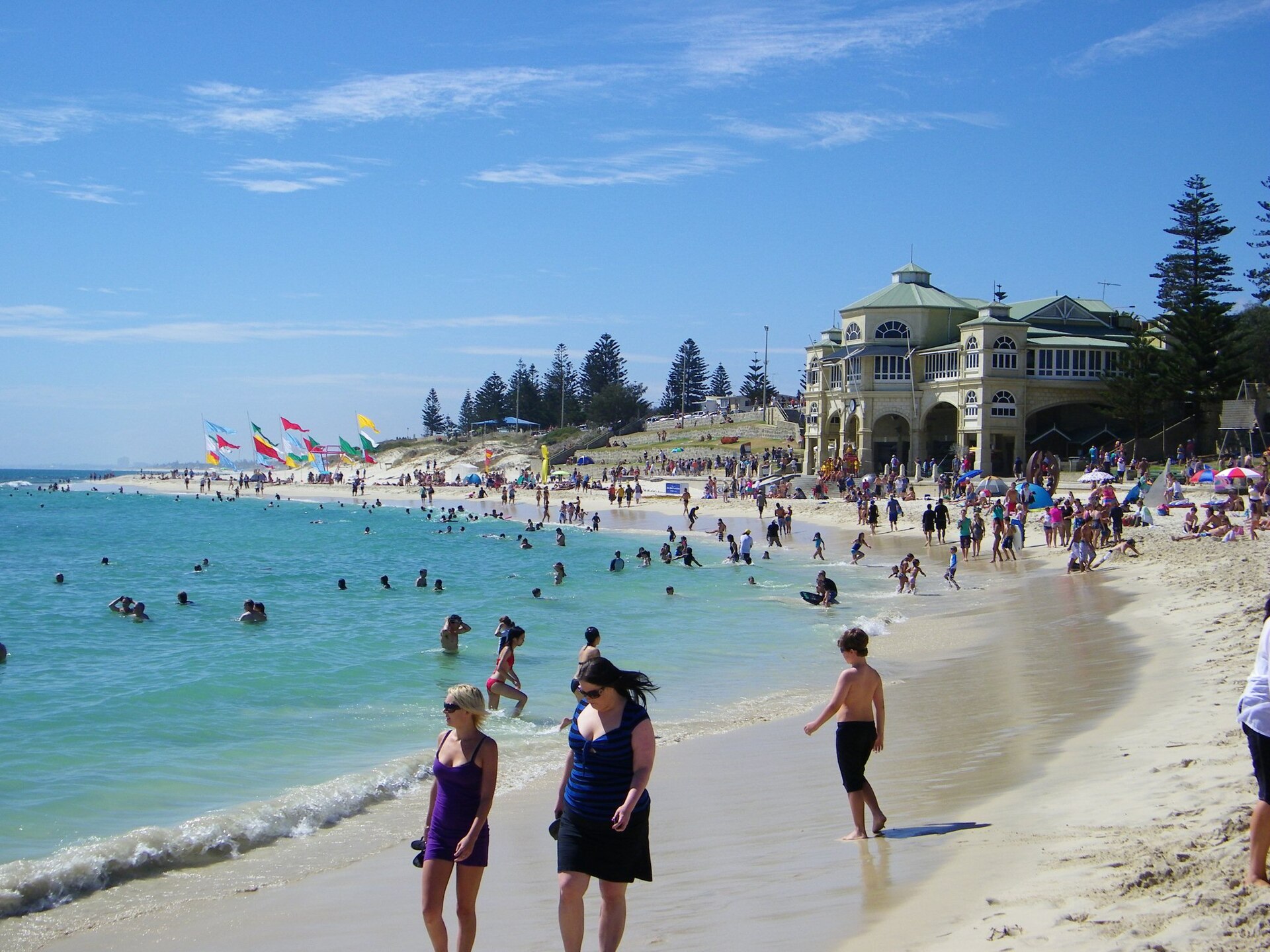
Photo: Michael Spencer / Wikimedia Commons, CC BY 2.0 · See the image credits page.
Perth is sold as a beach city with easy digging. Parts of that are true. A great deal of the metropolitan area sits on Quaternary sands that a machine loves, and a summer water table that, in some suburbs, stays out of the way. The rest of the truth is less photogenic. Those sands do not stand up. The older coastal limestone — the Tamala — throws pinnacles and cavities into a hole that was supposed to be finished by lunch. The younger dunes and the winter water table make dewatering a trade, not a surprise. And the same salt air that makes Cottesloe worth living in is trying to eat the stainless and the powdercoat.
If you brief a pool in Perth as if it were a clay hole in Melbourne with better weather, you will meet the geology in the variation register. Put a geotechnical note and a water-table guess on the table with the interior sample.
Spearwood, Bassendean and the sands people name in passing
Perth’s suburban soils are talked about in a local shorthand that is worth learning.
Spearwood sands are the yellow and brown sands of the older dune ridge, often with limestone not far below. They drain. They can be pleasant to work. They also hide the rock that the name “sand” was meant to exclude. A lot of the inner coastal and middle-ring western suburbs sit in this conversation.
Bassendean sands are paler, more leached, further east on the Swan Coastal Plain. They are famous among gardeners as hungry and hydrophobic. For a pool they are still a sand: poor standing ability, a need for compaction that is actually specified, and a habit of looking stable until a trench wall decides otherwise. They are not a reason to skip engineering. They are a reason to take compaction and temporary works seriously.
Safety Bay and other younger coastal sands sit closer to the present beach in places. They can be cleaner, looser and more involved with the water table and with coastal planning. Cottesloe, the western beaches and the older limestone ridges are not one soil profile. A street can change.
A geotechnical investigation on a custom pool is not precious. A few boreholes or test pits, a note on limestone, a water-level observation and a recommendation on temporary batter or shoring will pay for themselves the morning the excavator rings.
Limestone pinnacles, cavities and the hole that is not a rectangle
Tamala limestone is a coastal limestone with a personality. It appears as caprock, as pinnacles that rise through the sand, as pinnacles that sit in the middle of your deep end, and as cavities that make a footing conversation interesting. It can be a gift — a firm founding if the engineer agrees — and a cost, because it has to be broken, removed or designed around.
The usual Perth story is a sand excavation that suddenly rings. The machine is not the person to decide whether you drop the floor, step the pool, or break rock for a day. The engineer is. Budget a rock provisional in any Spearwood or coastal limestone suburb and do not sulk when it is used.
Cavities and pinnacles also affect neighbouring structures. A pool tight to a limestone footing or a neighbour’s limestone wall is retaining and excavation in a serious key. Undermining an old Fremantle or Cottesloe wall is a different project to a new-estate rectangle.
Karstic surprises are uncommon enough that you should not romanticise them and common enough that a competent local builder will have a story. Write a procedure, not a hope.
Dewatering, winter and the water that was always there
The Swan Coastal Plain has wetlands, a groundwater system people draw bores from, and a winter that still arrives even if the rest of the country thinks Perth is a desert. A deep pool, a spa pit or a plant-room sump can hit water in suburbs that felt dry when you bought in January.
Dewatering is a designed activity. It can require permission, a place to send the water that is not the neighbour’s rose bed, settlement time, and a method that does not pull fines from under a nearby footing. A cheap pump discharging to the street is how you meet the council and the water authority in the same week.
If the water table can rise after the pool is in, hydrostatic relief — a valve, a design that assumes groundwater — belongs in the engineering, especially on a fibreglass shell or any finish that hates an empty vessel. Do not empty a Perth pool in winter on a whim.
Summer excavation is often kinder. It is also when everyone else is pouring. Book the hole with the season in mind, not only the tiler’s diary.
Trenches that collapse and temporary works that are not optional
Sand stands at an angle of repose, not at the neat vertical the 3D render showed. A trench for a pipe, a pit for a tank, a cut for a wet-edge trough — these will ravel. People have been buried in suburban service trenches that looked shallow. Shoring, battering and keeping the family off the edge are part of the job.
The same physics undermines neighbouring paving and thin old footings. A pool 1.2 metres from a boundary on Bassendean sand is a temporary-works problem. The builder who “always does it this way” without a drawing is asking the sand to be clay.
Compaction under paving and under the pool surround matters more here than in a reactive clay story. Sand that was loosened and not put back properly becomes a trip a year later. Specify the pavement as a structure, not as a catalogue paver on loose spoil.
Coastal setbacks, salt and the suburbs that can taste the sea
Western beaches, the western ridges and anything with a sea breeze that leaves grit on the table are coastal specification zones. Setbacks from the coast and from erosion lines are planning matters — state coastal planning and the local scheme, not a vibe about “how close the Joneses went in 1987”. If you are in a hazard line or a local coastal overlay, the planner speaks before the excavator.
Salt air is the other half. 316 fittings as a minimum, better where water sits, aluminium and powdercoat chosen for coastal duty, a plant room that is a room rather than an open pad in the salt stream, and a wash-down habit: these are the coastal essay. Perth’s dry heat does not excuse the chloride. It can make powdercoat chalk faster.
Bore water used to top up a coastal pool can add metals and hardness. Test it. A pale interior and an iron-rich bore is a stain waiting for the first hot week.
Irrigation, limestone and the garden after the hole
Perth gardens run on reticulation. The water is often hard, sometimes from a bore, and it leaves white trails on limestone walls, limestone coping and any masonry that looks expensive in a photograph. Drip the plants. Do not put a spray head where it can mist the coping all summer. Choose a coping that can live with the water you actually have, or choose a water treatment, or accept the wipe.
Limestone as a building material and limestone as geology are cousins. A cut face of Tamala in a retained garden can be beautiful and can shed. It can also sit in a conversation with the pool engineer if it is holding the neighbour up. Do not let the landscaper and the pool engineer meet for the first time at the handover beer.
Hydrophobic Bassendean sand in the garden beds will shed the first rains and then dump them toward the pool if the levels are wrong. Falls, a legal backwash and an overflow that does not sit on the neighbour’s title are part of the landscape, not extras.
Plant choice in salt wind is its own list: coastal natives and the species Fremantle already proved, not a fern that looked good in a Melbourne courtyard book.
What to ask a Perth builder before you sign
Where have you hit limestone on this street, not in this suburb generally. What water level do you expect in August. Who engineers the temporary cut. What is the rock provisional and what is the dewatering provisional. How does spoil leave, and does the sand you export have a place to go. What grade of stainless is in the quote, in writing. Where does backwash go. Who applies for the dewatering permission if it is needed.
Ask to see a plant room in Cottesloe or City Beach that is five years old, not a twilight photograph from last November. Corrosion and chalked powdercoat are the local marking scheme.
Perth will give you a long swim season, a bright light and a water that looks like the Indian Ocean if you let it. It will also give you a hole that is only simple when someone has already paid for the knowledge of the sand and the stone. Put that knowledge in the brief and the rest of the cost and region conversation becomes ordinary again.
Photo: Michael Spencer / Wikimedia Commons, CC BY 2.0
Questions readers ask
- Why do Perth pool excavations go wrong even on “easy” sand?
- Clean sand looks friendly and will not stand in a vertical cut. Trenches collapse, neighbouring footings sit on the same dune, and a limestone pinnacle can appear in the last corner of the hole. Engineering and shoring are the job, not extras.
- Will I need dewatering?
- Often, if you are near the coast, a wetland, a low-lying suburb or a deep spa on a high water table. Dewatering is a licence, a discharge plan and a cost. It is not a pump in a hole on the day.
- Is limestone a problem for the finished garden as well as the hole?
- Yes. Irrigation on limestone and pale masonry leaves white trails. Bore water can be hard. Plant choice and watering method belong in the pool brief, not in a landscape afterthought.
Found an error? Use the contact form or read how we handle corrections in editorial standards.