Coastal pools: salt air, corrosion and durability
Chloride does not care that the pool is inland of the dune. Specify 316 or duplex stainless, coastal-grade coatings, hardware that can be replaced, and a wash-down habit — from the northern beaches to the Queensland coast and the west.
Custom Pools editorial team · 28 December 2025 · Updated 8 February 2026 · 19 min read
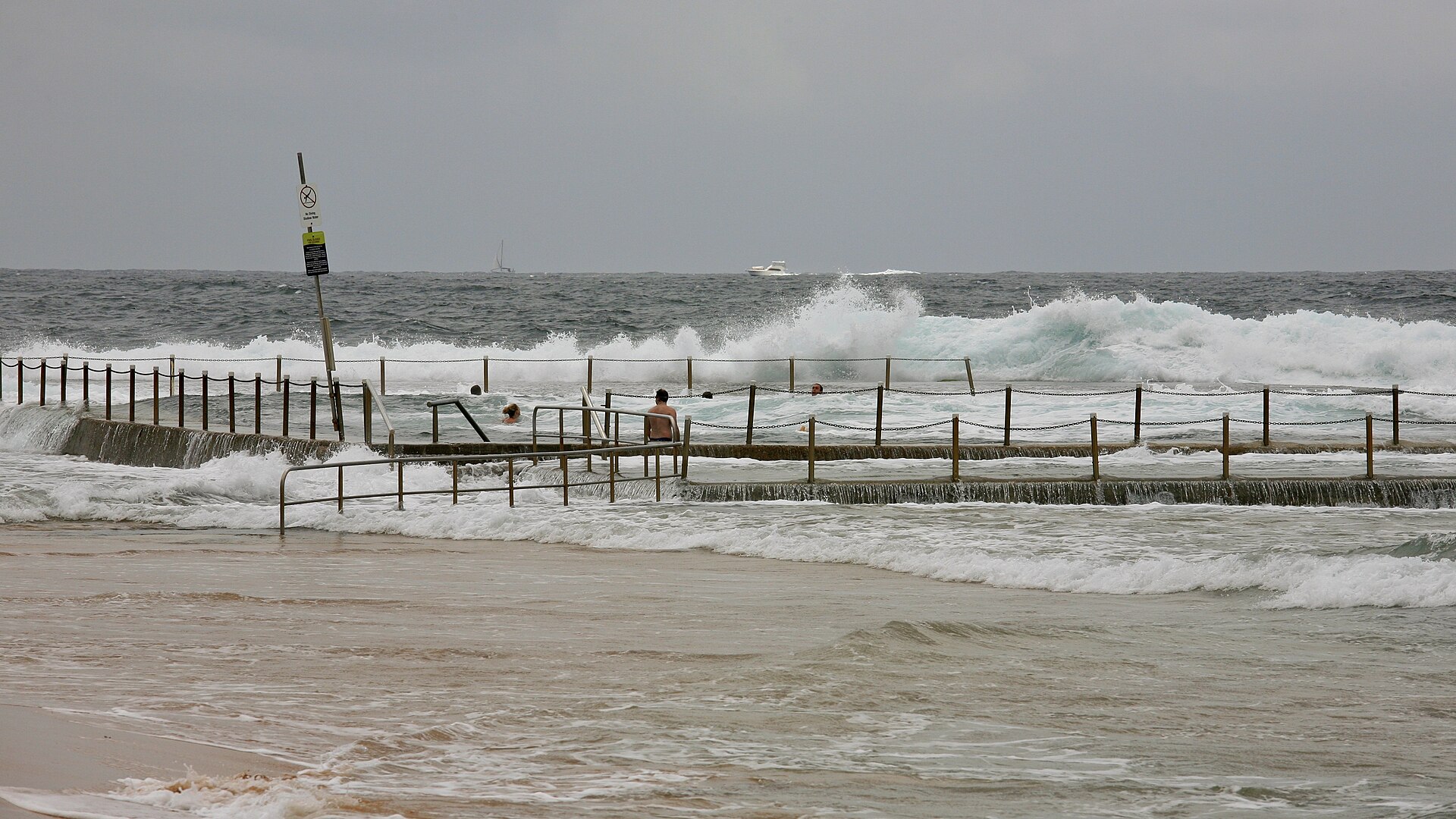
Photo: Alex Proimos / Wikimedia Commons, CC BY 2.0 · See the image credits page.
Coastal Australian pools fail first at the fasteners. The pebble still looks like the sample. The water still photographs. Meanwhile the gate hinge has tea-stained, the light ring has pitted, the powdercoat has blistered at every cut edge, and the glass clamp is weeping rust onto a pale coping. Chloride in the air and chloride in a salt pool are the same family of problem. The house that can taste the sea on a nor-easter is in that family even if the dune is two streets away.
This is a specification essay, not a scare. People swim in public seawater pools at Mona Vale, Coalcliff, Norah Head and Avoca all year; those places are useful analogues for what salt does to concrete, metal and feet. A private court can last if you choose alloys, coatings and a wash-down habit on purpose, and if you stop buying inland hardware because it was on special.
How close is coastal
If you can smell the sea from the backyard, specify as coastal. If you are in the first few rows of dunes or on a headland, specify as aggressive marine. If you are a kilometre inland on a ridge that catches a sea breeze — much of the Sydney northern beaches, the Gold Coast hinterland edge, Cottesloe’s near streets, Adelaide’s western suburbs — you are still in the conversation. Dry heat does not cancel salt. It leaves it on surfaces.
A salt-water chlorinator makes the pool itself a chloride environment regardless of postcode. Coastal air then adds the second dose to every object that never touches the water: the fence, the outdoor kitchen, the lights, the shower mixer. Inland salt pools can be kinder to the fence and cruel to the rails. Beachfront fresh-water pools (there are a few) reverse that. Most Australian coastal family pools are both.
304, 316 and 2205 — say the grade in the quote
Stainless is a family. 304 is the inland handrail that looks bright in a warehouse and tea-stains in a season of salt. It has no business as a structural or regularly wetted fitting on a coastal or salt pool.
316 — sometimes sold as marine grade, which is a start and not a benediction — is the ordinary coastal specification for rails, ladders, visible trims and many light rings. It still pits in a crevice, under a deposit of salt, or against a less noble fastener. It must be rinsed. It must not be paired with a cheap steel screw that turns the stainless into the cathode of a small battery.
2205 duplex is the step for wet-edge trough fittings, structural ties, and anything that stays wet, loaded and miserable to replace. It costs more in the quote and less in year eight. If a builder has never written 2205 on a page, they may not have done this edge before.
Passivation, welding quality and grinding matter as much as the grade. A 316 rail welded with the wrong consumable and left brown at the join will fail like a worse alloy. Ask who fabricates, not only who supplies.
Do not mix bright aluminium, 304 screws and 316 rails in a damp clamp and then act surprised. Isolated, specified fasteners are part of the drawing.
Powdercoat, aluminium and the coastal fence
Aluminium pool fencing is a sensible coastal material if the alloy, the pre-treatment and the powder system were chosen for marine duty. It is a poor one if the panels were the cheapest slat from a catalogue, cut on site, and left with raw ends. Corrosion starts at the saw cut, the drill hole and the underside you never wash.
Look for a coastal or marine warranty that is actually written, a film thickness someone will admit to, and drainage in hollow sections so they do not become salt tanks. Weep holes that a painter filled are a failure mode. Dark colours chalk and fade faster in Australian UV; that is appearance more than structure, but it is the appearance you paid for.
Steel fences on the beachfront are a maintenance career. Gates fail first: hinges, latches and closers that must still meet a life-safety standard after two summers of salt. A beautiful panel with a seized closer is not a barrier. Keep a spare latch. Test the gate every year.
Glass, clamps and the stain on the coping
Frameless glass is the coastal dream and the coastal maintenance plan. The glass is largely fine. The clamps, spigots, patch fittings and fasteners are the story. Specify the metal as you would a rail. Keep water from sitting in the clamp. Rinse. Accept that a white limestone or pale travertine coping will show the first rust bloom like a witness.
Semi-frameless and framed systems put more aluminium in the game and can be easier to maintain if the system is coastal-rated. They are not a moral failure. On a true beachfront they are often the adult choice.
Glass also wants a wipe. Salt film is abrasive and ugly. A household that will not wash glass should not buy a glass room around the water. Coping and paving should be chosen with the knowledge that someone will stand on them with a hose.
Lights, niches and the electrics that sit in chloride
Underwater lights fail at the cable gland, the niche and the trim ring. Coastal and salt-pool specifications want a fitting that can be serviced from the deck if possible, a niche material that matches the chloride story, and a transformer or driver that sits high and dry. Cheap extra-low-voltage fittings from an inland job lot are how you drain to replace a light.
Deck lights get the same salt as the gate. Use fixtures rated for the location and stainless that is actually 316. Bonding requirements do not relax because the view is good.
Covers, wash-down and the habit that saves the quote
A cover keeps debris off and can keep some salt spray off the water. It does not keep salt off the fence. The habit that does is fresh-water rinsing: rails, clamps, gates, shower mixers, the window that faces the sea. After a blow, rinse. After a heatwave that has baked the salt on, rinse. A household that treats this as optional will repurchase hardware.
Do not rinse with bore water that is itself hard or salty. You are decorating.
Mild detergent and water; a technician for the stubborn pit. Acid on the wrong surface etches a coping to remove a stain the fastener caused. Cheap steel furniture rusts onto pale paving and then gets blamed on the pool builder.
Plant rooms versus an open pad
An open equipment pad on the windward side of a coastal house is a sacrificial altar. The heat pump coil, the chlorinator box, the heater jacket and every conduit gland will live in salt aerosol. Some airflow is required; a blast of marine air all year is not.
A ventilated plant room, a shed with louvres that are themselves coastal, or at least a wall that breaks the prevailing salt wind, changes the life of the machines. Heat pumps still need a volume of air and a clear coil; they can have that inside a designed enclosure. Do not brick them into a hot tin cupboard. Do not leave them as yard sculpture.
Keep chemicals in a cool, dry, legal place, not in a sun-struck box that shares air with the switchboard. Coastal humidity finds a way.
NSW, Queensland and Western Australian coasts are cousins
The Sydney northern beaches, the Illawarra (Coalcliff’s public pool is the extreme classroom), the Central Coast around Norah Head, and the pretty headlands toward Avoca all combine salt, sandstone or dune, and a household that wants glass. Specify as marine, inspect gates every season, and do not trust a western-suburbs quote.
Queensland’s coast adds heat, wet-season moisture and, in the north, a tropical care load on top of the chloride. Corrosion plus algae plus a screen full of salt is a different weekend. Powdercoat and electrics suffer from the moisture as much as from the salt. Dry the room. Use the cover.
Western Australia’s beaches add dry UV, limestone grit and a long season of use. Coatings chalk. Limestone shows rust immediately. Bores complicate the rinse water. The specification is still 316 and up, still a plant room, still a wash-down — with a harder sun in the story.
Southern coasts have colder salt. The alloys do not get a holiday.
Write durability into the brief
Put the distance to the sea and the words “coastal specification” on page one. Ask for grades, not brand adjectives. Ask for a maintenance note at handover.
A coastal pool that is specified and washed is an ordinary Australian luxury. One specified like an inland estate is a short story about stains. The rest of the cost and region library is money and approvals. This page is the metal that still looks like a pool in year ten.
Photo: Alex Proimos / Wikimedia Commons, CC BY 2.0
Questions readers ask
- Is 316 stainless enough on the beachfront?
- It is the ordinary coastal upgrade from 304, not a magic alloy. Use it for rails and visible trim, keep it rinsed, and move to duplex 2205 where water sits against a structural or wet-edge fitting you cannot face replacing.
- Why does powdercoat fail so fast near the sea?
- Salt sits in the film, the sun cooks it, and cheap pre-treatment lets corrosion creep from a cut edge or a screw hole. Buy a coastal-rated system, keep weep holes open, and expect maintenance — not a twenty-year showroom face.
- Should coastal equipment sit in the open?
- A ventilated shed or a true plant room lasts longer than an open pad in the salt stream. Heat pumps still need air; they do not need a nor-easter on the coil all winter. Design the room for both.
Found an error? Use the contact form or read how we handle corrections in editorial standards.