Keeping a Sydney pool healthy through summer
Sydney’s pool season is heat, gum-leaf tannin, a crowd after Australia Day and the February storm that turns a clear rectangle into tea. Chemistry has to move as fast as the weather.
Custom Pools editorial team · 8 January 2026 · Updated 22 January 2026 · 18 min read
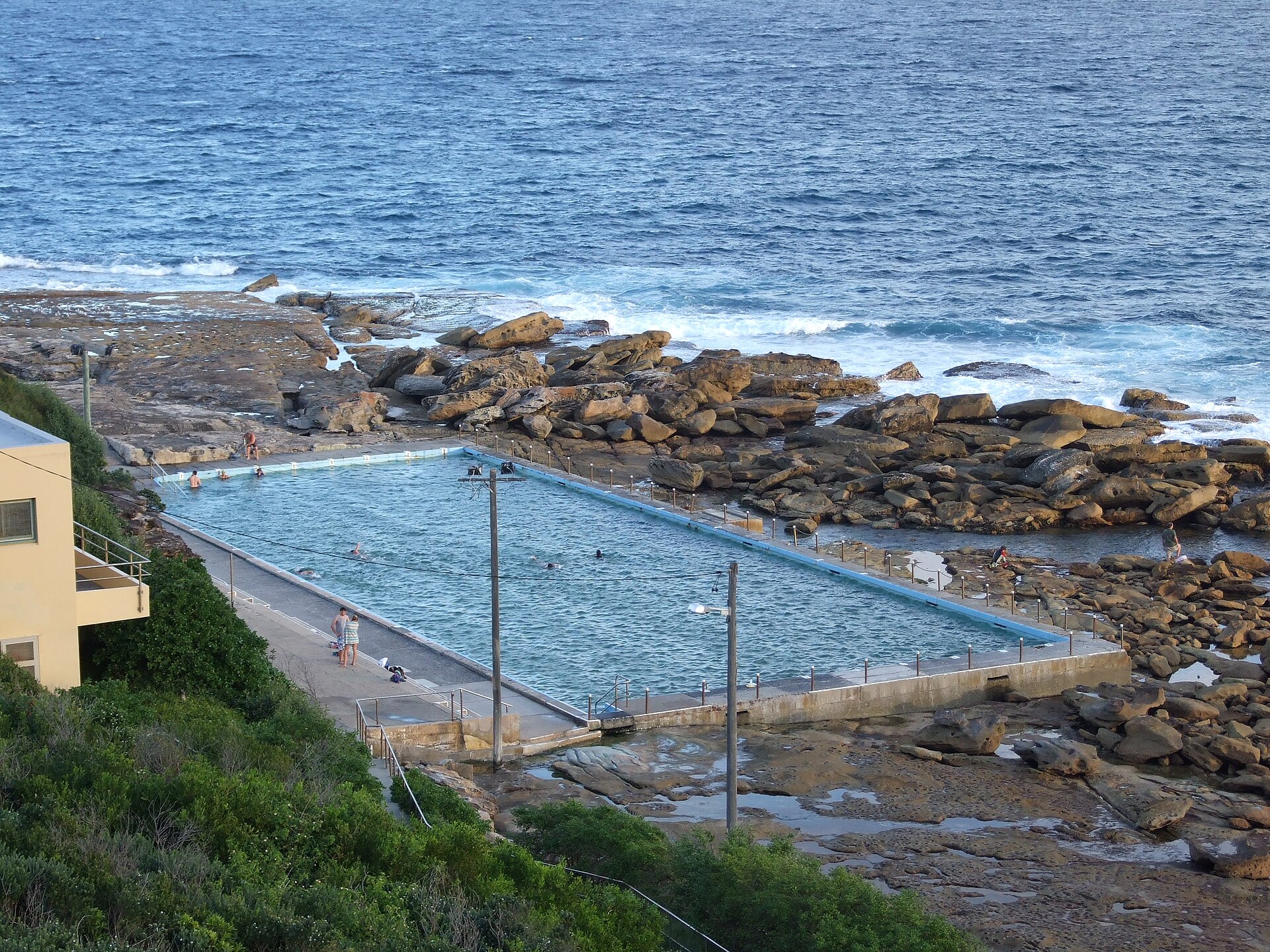
Photo: Mhsb / Wikimedia Commons, public domain · See the image credits page.
Sydney does not have a gentle pool season. It has a run of hot weeks, a public-holiday crowd, a north-easterly that drops a week of angophora leaves onto the surface, and then a February low that empties the sky onto the western suburbs in an afternoon. The water that looked like a hotel court on Boxing Day can look like cold tea by the first school week. That is not bad luck. It is the climate the sanitiser has to be sized for.
The second Sydney fact is that the backyard is a garden. Eucalypt litter, paperbark flowers, jacaranda bells in the inner west, fig mess on the older blocks, and the fine phosphate dust that washes off a tired lawn all arrive in the same skimmer. Landscaping is water quality. A pretty canopy without a plan for litter is a weekly argument with a leaf rake.
Heat, ultraviolet light and the residual that vanishes
A pale pool in full sun on a 38-degree western-Sydney afternoon is a harsh ultraviolet reactor. Free chlorine that would have lasted the day in September is gone by lunch unless cyanuric acid is in a sensible band and the chlorinator or the dosing pump is actually producing. Test in the late afternoon, not only at 8am when the water is flattering.
Stabiliser is not a winter topic that you can ignore until Easter. If you commissioned the pool in a mild October and then spent December throwing the occasional tablet into a floater “for luck”, you may already be climbing toward a lazy residual. Write the cyanuric acid number down. If you cannot find last month’s reading, take one before you buy more product.
Heat also accelerates algae. Black-spot algae on a pebble interior — the small dark pinheads that do not brush off — loves a warm, under-chlorinated, slightly neglected wall in a splash zone. Brushing, a residual that is actually there, and attention to circulation dead spots (behind a bench, under a ladder, along a step that the return does not reach) are the prevention. Once it is established you are in for a fight that may include a specialist treatment and a lot of brushing. Do not confuse it with dirt. Dirt moves.
Australia Day, bather load and the week that follows
The calendar is a water event. Late December through the Australia Day weekend is when Sydney households put more bodies, more sunscreen and more fruit juice into the water than in the whole of April. A chlorinator set for a quiet family of four will not keep up. Run the pump longer. Lift the output. If the water goes dull and smells sharp, you have chloramines: shock with a measured oxidiser, keep the cover off until the residual settles, and filter.
Sunscreen is oil and metal in disguise. It makes scum lines. A weekly wipe of the waterline tile is not vanity; it is how you stop a yellow collar that later needs a stronger clean. If you have a pale interior and a household that lives in SPF 50, accept the wipe as part of summer, the way you accept mowing.
Phosphate arrives with the people and with the garden. It is plant food. Algae is a plant. You do not need a precise laboratory number to know that a lawn that drains toward the pool, a recently fertilised bed and a week of bathers is a phosphate story. Phosphate removers exist and have a place after a bloom. They are not a substitute for a residual. If a technician leads with phosphate every visit and never talks about free chlorine or filtration, they are selling a bottle.
February storms, dilution and the debris that is not romantic
East-coast lows and ordinary southerly busters do two things to a Sydney pool. They dump organic debris — leaves, soil, roof grit, the contents of a blocked gutter — and they dilute the water you had balanced. A salt reading falls. A chlorine residual falls. Cyanuric acid falls a little. Phosphate and mud rise. The surface looks dark because tannin and soil are in suspension, not because the pool has “gone organic”.
The first job is physical. Scoop. Empty the skimmer so it can skimmer. Backwash or clean the cartridge until the pressure or the flow says you are through the muck. Do not pour a suitcase of chemicals into a pool that still has a flowerbed on the floor. The second job is chemistry: restore the residual, check salt if you run a cell, check pH (rain is often acidic; the cell will then push the other way), and run the filter longer than you feel like.
If the storm has put enough soil in that the water will not clear, a clarifier or a floc and a vacuum-to-waste may be the honest path. Vacuum-to-waste spends water. In a city that remembers drought, that should sting. It is still better than living with a brown pool for a fortnight while you “let it settle”.
Lighting after a storm is how you see what you missed — a drowned possum is not theoretical on some bushland blocks, and a toy on a main drain is how pumps die. If you are in the water at night, the lighting should show the floor, not only the waterline.
Gums, tannin and the garden you planted on purpose
Sydney’s characteristic trees are messy. That is why people love them. Angophora and blackbutt drop bark and leaf that stain. Brush box flowers. Melaleuca drops fine litter that escapes a wide-gapped basket. If the canopy sits over the water, you have chosen a maintenance rate. A cover on workdays is the adult response. A darker interior hides the tea-stain; it does not remove the organic load.
Do not poison the tree to save the pool. Prune for clearance, choose species away from the water when you replant, and put the skimmer where the prevailing summer breeze actually sends the leaf. A skimmer on the wrong edge is a decorative grille.
Mulch beds that shed into the paving, and gravel that walks into the water on wet feet, are design errors. A rinse-off shower and a bit of grating at the gate do more for summer water than a second bottle of clarifier.
When to shock, and when to stop
Shock is a tool. Use it when the water has had a load it cannot oxidise on the daily residual: a party, a storm, a visible green cast, a combined-chlorine reading that stays up, a smell that is sharp rather than clean. Use a product you understand. Liquid chlorine lifts the residual without adding stabiliser — usually the right Sydney summer move. Stabilised tablets are not a shock; they are a slow dose and a cyanuric-acid donation.
Do not shock on a schedule because a calendar said so. Do not shock and then immediately cover and walk away without a later test. Do not mix oxidiser with acid in a bucket because a forum said it would “balance”. If you are out of your depth, pay a water technician for a month of summer visits and watch what they do. The aim is that you can copy it in February, not that you own a cupboard of unlabelled white powders.
Black spot that survives a shock and a brush needs a plan: confirm the residual is holding, confirm circulation, consider a targeted treatment, and accept that a neglected pebble can hold spores in pits. A new interior is not the first answer. A month of honest residual often is.
Water, drought memory and filling without folklore
Sydney households of a certain age remember Level 3 thinking: buckets, grey water, a guilty hose. Those rules have been tightened and loosened with the dams. This essay will not invent a current ban. Before you fill, top up or dump and refill for chemistry, read the water utility and the state advice that apply on that day. A historical restriction is not a present one. A present one is not optional.
The practical ethic is still not to waste the water you have. Fix leaks. Use the cover. Do not drain to fix a cyanuric-acid problem you created with tablets. If you must dilute, do it as a planned partial drain, not as an overflowing ornament because the auto-fill stuck during a storm.
Bore water and tank water have their own metals and tannins. Test them.
A Sydney summer routine that actually happens
A routine that needs an hour every dawn will die in week two. After each swim day: glance at the water, empty the basket, pull the cover on. Twice a week in January and February: test free chlorine and pH, adjust, brush the steps. Weekly: a fuller test, a waterline wipe, a filter check. After every serious storm or crowd: physical clean first, then chemistry, then a long circulation.
If you travel in January, pay someone who will do those things, not someone who will “check it” from the side gate. Leave written numbers.
Summer water in this city is not mysterious. It is fast. The households that stay clear treat February as a weather system, not a failure of character, and let the garden and the sanitiser be designed for the same block. The rest of the water, climate and care library assumes that speed.
Photo: Mhsb / Wikimedia Commons, public domain
Questions readers ask
- When should I shock a Sydney pool in summer?
- After a heavy bather day, after a storm that puts organic debris in the water, or when combined chlorine stays high and the water looks dull. Shock is a measured oxidiser dose and a long filter run, not a weekly personality.
- Do gum leaves stain a pool?
- They tannin-tint the water and feed a nutrient load if they sit in the skimmer or on the floor. Scoop them the day they fall. A dark interior hides the tea; it does not remove the waste.
- Can I fill from the tap after a dry spell?
- Follow the current Sydney Water and state rules on the day you fill — they change with drought and dam storage. Historically, outdoor-use limits have come and gone. Do not assume last decade’s ban is still in force, and do not waste water you may later have to drain for cyanuric acid.
Found an error? Use the contact form or read how we handle corrections in editorial standards.