Council approvals, DAs and complying development for pools
A pool is building work and a barrier is life safety. NSW, Victoria and Queensland get you there by different paper. None of this is legal advice for your block.
Custom Pools editorial team · 12 February 2026 · Updated 1 March 2026 · 19 min read
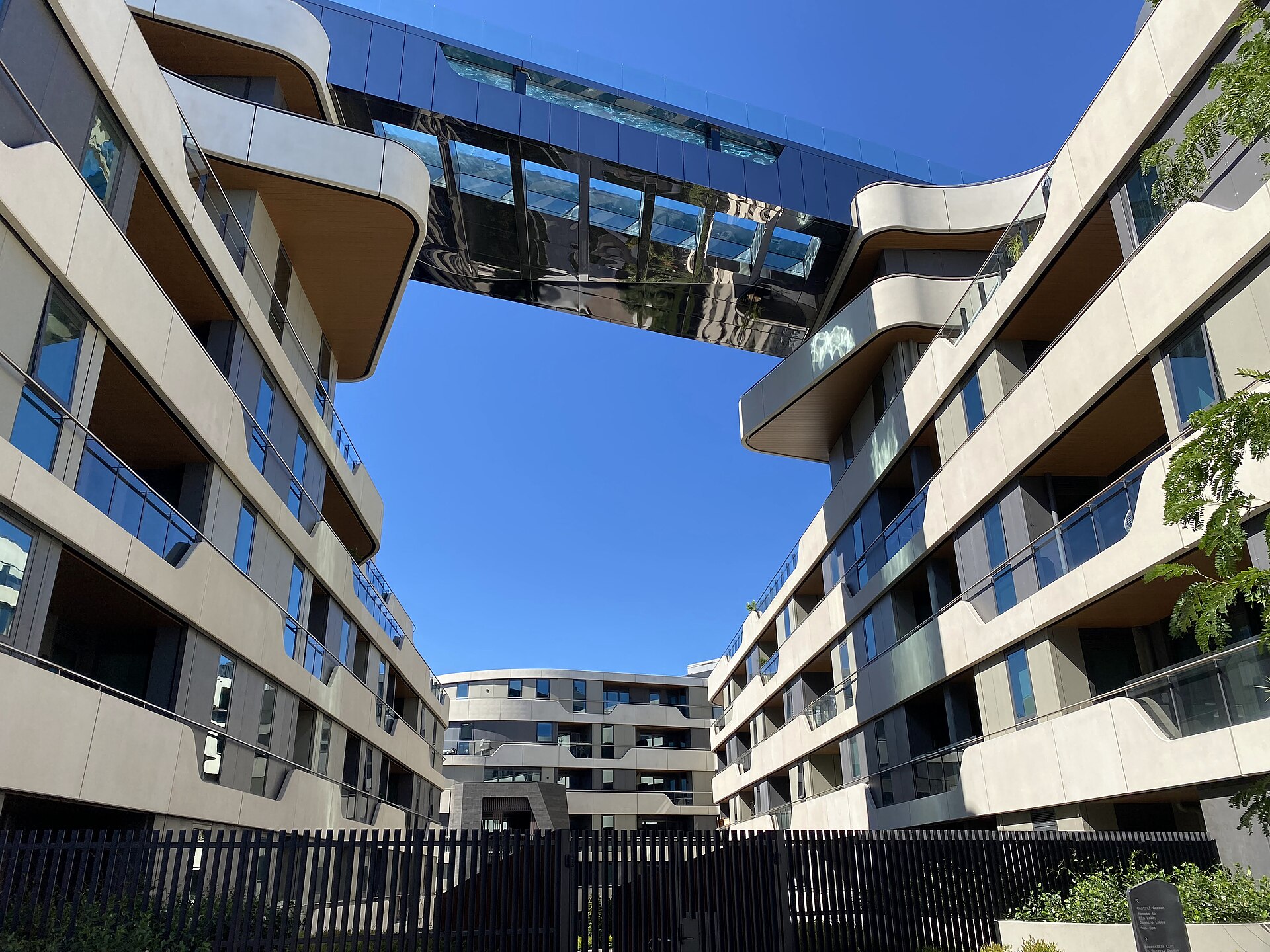
Photo: -wuppertaler / Wikimedia Commons, CC BY 4.0 · See the image credits page.
A backyard pool in Australia is not a piece of outdoor furniture you assemble and then “see about the council”. It is building work. It has a structure, a water-holding volume, a barrier that exists to keep small children out, and a set of pipes that must not flood the neighbour. The paper that makes that legal is different in New South Wales, Victoria and Queensland, and different again when a heritage overlay, a big tree or a stormwater easement is on the title. This is a map of the usual paths. It is not legal advice, not a substitute for the current state instrument, and not a permission slip for your block.
Bring a survey and the title to the first design meeting. Approvals fail on facts that were sitting in the packet: a sewer that bisects the only possible plant room, a right of way, a flood level, a tree the council has already met.
The idea, before the acronyms
Somewhere, a competent person has to confirm that the structure is safe, that the water will not undermine a neighbour, and that the barrier meets the standard your state has adopted — in practice a conversation with AS 1926 and the local law that sits on top of it. Read pool fencing and Australian standards as the physical essay. This essay is the paper.
That competent person may be a private certifier, a municipal building surveyor, a council planner, or more than one of them. Inspections happen at stages: often steel and bonding before the concrete disappears, later the barrier and the final. Occupying the water before the barrier is certified is how families end up in the part of the newspaper nobody wants.
Exempt development — truly small work that needs no approval — is a narrow idea. A custom pool is almost never in it. If a salesperson says you do not need anyone, leave.
New South Wales: complying development and the DA
NSW is the state where households hear “CDC” first. Complying development is a fast-track building approval issued by a council or a private certifier when the proposal sits inside a published box: the State Environmental Planning Policy that covers complying development, plus the rule book that comes with it. Swimming pools can fit that box — setbacks, height of coping and barrier, location behind the building line, site constraints — or they can miss it by a metre.
If you miss the box, you lodge a development application with the council and then a construction certificate. That is slower, more public, and sometimes the only honest path on a tight inner-city lot, a heritage item, a battleaxe, or a design that wants the pool in the front garden. Sloping and tight blocks miss the box more often than estate rectangles.
A private certifier is not a magician. They can issue a CDC when the SEPP is satisfied. They cannot erase an overlay, invent a setback or certify a barrier that the standard does not allow. Shopping for a certifier who “just gets it through” is how you buy a piece of paper that fails later.
Neighbours in NSW notice pools. Even a CDC can produce a conversation about noise, a pump location and a fence on a common boundary. A DA produces a formal one. Budget time.
Victoria: building permits, and planning when an overlay says so
Victoria’s ordinary path is a building permit under the Building Act, issued by a municipal or private building surveyor. Many suburban pools on straightforward lots never see a planning permit. The building surveyor is still not optional. The barrier is still not optional. The siting still has to meet the building regulations and any relevant part of the planning scheme.
Planning arrives when the scheme says it does: heritage overlays, neighbourhood character, significant landscape, flooding, a lot below a certain size in some zones, a variation to a boundary setback you cannot meet. Inner Melbourne and the older eastern suburbs hit this more often than a new estate in Wyndham. The Camberwell-style tight rear garden in the photograph is exactly the sort of place where the building permit is certain and the planning conversation depends on the overlay map you have not opened yet.
Do not let a pool company pour because “Vic doesn’t need council”. Someone still issues a permit. Someone still inspects. Someone still wants a protection-of-the-public story if you are excavating near a footpath.
Queensland: building approval and pool safety as a living duty
Queensland treats pool safety as a visible, ongoing regime, not only a day-one certificate. Building approval is still required for the structure. A pool safety inspector and a pool safety certificate sit in the household’s life when you sell, when you rent, and when the law says a certificate must exist. The Queensland Development Code’s pool-barrier provisions, and the pool safety standard the state points to, are the documents your inspector is using. They are not a vibe.
Building approvals in Queensland are commonly handled by private building certifiers. Councils still appear for plumbing, for some planning triggers, and for the overlays that exist everywhere: flooding, coastal, character, vegetation. The Gold Coast and Brisbane have seen enough pools that the process is familiar. That familiarity is not a reason to skip the application.
If you buy a Queensland house with a pool, the certificate status is part of due diligence. An old fence that grandfathered something in a previous decade may not be what you can leave for the next owner.
Heritage, trees and the things on the title
A heritage overlay or a listed item changes more than the colour of the mortar. It can decide whether you may excavate near a house, whether a glass fence is thinkable, whether the pool may be seen from the street, and how long the letter takes. Engage someone who has done a pool on a heritage lot, not someone who has only done estates.
Trees are structures in slow motion. Significant-tree registers, vegetation protection overlays and neighbourhood character controls can make the jacaranda in the far corner more important than your preferred eight-metre lap. An arborist report is cheaper than a refused application or a dead tree you were not allowed to kill. Design around the tree or apply to remove it. Do not assume the excavator will “be careful”.
Easements, sewers and stormwater lines are not negotiable because the water would look better over them. Water authorities have setback and build-over rules. A plant room on a sewer is a future excavation through your pebble. Stormwater from the pool — backwash, overflow, deck drainage — needs a legal place to go. In some streets that is the kerb; in some it is an on-site system; in some it is a fight. “It just runs onto the lawn” is how you meet a neighbour in writing.
Bushfire-prone land, flooding, acid sulfate, mine subsidence and coastal hazard zones are all overlays that change the structure or forbid the location. If the planning map is a rainbow, budget for reports.
Certifiers, councils and who you can ring when it goes wrong
Private certification exists because states wanted speed and capacity. It works when the certifier is independent, insured and actually inspecting. It fails when the certifier is the builder’s mate and the steel was “inspected from a photo”. You are allowed to ask who the certifier is, who pays them, and how many inspections are in the contract.
Councils remain the place for planning merit, for complaints, for some plumbing, and for the overlay you hoped to ignore. They are not uniformly slow or uniformly helpful. A pre-lodgement conversation on a difficult site is often worth a month of guessing.
If two professionals disagree — a certifier who says CDC and a council officer who says DA — stop pouring. Resolve the path. Concrete is a poor interlocutor.
Inspections, occupation and the week you want to swim
Typical inspection points include excavation or steel (reinforcement, cover, bonding of metal parts), sometimes drainage or waterproofing on a wet edge, and always the barrier before the pool is treated as usable. Lighting, fencing heights, gate latches, non-climbable zones and the house openings that form part of the barrier are the usual final-inspection arguments.
Do not fill and invite children because the interior looks finished. A pool without a certified barrier is a hazard with pretty water. Temporary fencing during construction is its own duty; a pile of reinforcing mesh is not a fence.
Keep the certificates. The next owner, the insurer and a future council will ask. So will you, six years later, when a gate sag and nobody can remember who built it.
A practical order of operations
Survey and title first. Overlays second. A sketch that already shows the barrier, the plant room and the overflow third. Then a conversation about CDC versus DA, building permit versus planning permit, or Queensland building approval — with a named professional. Then a specification you can lodge. Then the hole.
Owners who reverse this — hole, then paper — spend the rest of the project asking the structure to become legal. Owners who treat the barrier as architecture from day one usually get to swim. The rest of the cost and compliance library is money and soil. This page is the permission to start.
Photo: -wuppertaler / Wikimedia Commons, CC BY 4.0
Questions readers ask
- Is this legal advice?
- No. It is a high-level map of how Australian pool approvals often work. Your title, overlays, state law and the current planning instrument decide the path. A licensed certifier, building surveyor or council planner must speak to the site.
- Can a private certifier approve a pool in NSW?
- Often, if the work is complying development and the box of SEPP rules is actually ticked. If it is not complying, you are in a development application with the council. A certifier cannot wish a heritage overlay away.
- When do I need to think about the fence?
- In the first sketch. The barrier affects doors, windows, boundary fences and the path from the kitchen. Leaving it until after the pour is how households fail a final inspection.
Found an error? Use the contact form or read how we handle corrections in editorial standards.